← Phillip Kingston

Heritage

Clan Maclaine of Lochbuie & Clan Ross

Two Highland descents: the Macleans of Mull, from whom the Maclaines of Lochbuie and the McFadyen sept come, and the earls of Ross, whose Gaelic name the Andersons carry.

Overview

Two clans meet in this family. The Maclaines of Lochbuie hold the southern end of Mull from the fourteenth century, and the McFadyens, whose name is also written MacFadyen and MacFadzean, were on that ground before them. Clan Ross takes its Gaelic name, Clann Anndrais, from Andrew, which is the same name the Andersons carry. What follows is the documented outline of both, with every claim sourced, the weak links marked as weak, and a guide to how each of the four names has actually been spelled since the thirteenth century. For what these lines lived inside before any of it was written down, see Before the tree, which runs from the Beaker migration to 1600.

Privacy

Living people are withheld from this page. Their names and dates are removed before the data is published, not hidden in the browser, so they are not present in the page source.

01

Origins

Son of the servant of Saint John

The Macleans are Clann 'IllEathain in Gaelic, an anglicisation of MacGilleEathain, the patronymic of a name meaning servant of Saint John: so son of the servant of John.21 The clan takes that name from Gillean of the Battle Axe, Gilleain na Tuaighe, placed by the clan at roughly 1210 to 1263, and tradition puts him and his sons at the Battle of Largs in 1263 where Alexander III turned back the Norwegian fleet.121 Largs is tradition, not record, and is best read that way.

Two brothers, two charters

Gillean's great-grandson Iain Dubh, Black John, had two sons: Eachann Reaganach, Hector the Stern, and Lachlan Lubanach, Lachlan the Wily. Each took a separate charter of lands on Mull from the Lord of the Isles, Hector at Lochbuie and Lachlan at Duart.14 The date is not agreed: the encyclopaedic account says about 1350, the chief's own society says 1360.123 That division is the origin of the two clans, and of the long argument about which is the elder.

Fearchar and the earldom of Ross

Clan Ross begins further north and rather earlier, in a church office rather than a warband. Applecross was a monastery founded in 672 by Máel Ruba, who died there in 722; the deaths of several of his successors as abbot are recorded in the Irish annals into the early ninth century.24 Fearchar mac an t-Sagairt, son of the priest, is held to have come of the lay abbots of that house.37 He put down a rebellion against Alexander II, was knighted in 1215, appears in a charter of 1224 to 1231 styled Comes de Ross, and held the earldom by 1232.3

As far back as the record goes

1296 the year both Maclean and Anderson first appear in a dated Scottish document

Beyond the traditions, this is where the paper starts. A Maclean and an Anderson are both first recorded in 1296, in the homages taken across Scotland for Edward I: Gilmore Maclyn, and David le fiz Andreu, burgess of Peebles.2021 A McFadyen appears in 1304, when Malcolm Macpadene witnessed a charter at Achichendone in Kintyre.20 Everything earlier than that, for any of these names, is tradition, inference or a genealogy written down centuries after the fact.

Maclaine of Lochbuie

Mac'ill-Eathain Lochabuide1

Motto
Vincere vel Mori — to conquer or die1
Crest
A branch of laurel and a branch of cypress in saltire, surmounted of a battleaxe1
Seat
Moy Castle, Lochbuie, Isle of Mull; Lochbuie House from 17521
Chief
Lorne Maclaine of Lochbuie, 26th chief, 21st Baron of Moy5
Sept
McFadyen, listed by the clan society as MacFadzean5

Clan Ross

Clann Anndrais · Na Rosaich2

Motto
Spem Successus Alit — success nourishes hope2
Crest
A dexter hand holding a garland of laurel2
Seat
Balnagown Castle, Easter Ross, from a charter of 13742
Chief
Fiona Campbell Ross of Ross and Balnagowan, recognised 20242
Septs
Anderson, Andrew, MacAndrew, Gillanders and others2

02

Maclaine of Lochbuie

Moy Castle and the barony

Moy Castle is a tower house at the head of Loch Buie, and it stayed the chiefs' residence for four hundred years until Lochbuie House replaced it in 1752.1 Tradition attributes it to Hector Reaganach, but most of the surviving tower belongs to the first half of the fifteenth century and no contemporary record names a builder, so the attribution is inherited rather than documented.23 The lands were erected into the barony of Moy in 1542 under the sixth chief, which is why the chief is styled Baron of Moy to this day.15

When Maclean became Maclaine

Both houses sat on the Council of the Lord of the Isles, and which of Lochbuie or Duart is the senior line has been disputed for centuries and is not settled here.5 The spelling that now divides them can be dated: it was Hector, eighth of Lochbuie, who began writing the name Maclaine, and later chiefs kept it.1 Before that the Lochbuie chiefs appear as Macleans, as when John M'Gilleoin is recorded in 1485 as dominus de Lochbuye.20

An Irish origin story

The clan also carries a tradition of descent from Maurice Fitzgerald, the Anglo-Norman who came to Ireland with Strongbow, with offshoots said to have reached Scotland in the thirteenth century.1 Origin legends of this kind attach to many Highland clans and are generally later constructions; the encyclopaedic account of the clan notes the stories without substantiating them.21 It is recorded here as tradition, not as descent that can be traced.

Losing the ground

The line did not end but the land did. The twenty-fourth chief, Kenneth Douglas Lorne Maclaine, lost the Lochbuie estates in a contested lawsuit that ended in foreclosure in March 1922, and the property was sold that year to Sir Richard Garton, whose descendants still farm it.1 The chiefship carried on regardless, which is the point worth holding on to: a chiefship is an office in Scots law, not a landholding.

03

The McFadyen Sept

Son of little Patrick

The name is Gaelic Mac Phàidein, son of Pàidean, a diminutive of Pàdraig: son of little Patrick.2026 So unlike Ross, which is a place, and unlike Maclean, which is a church office, this family name records an individual person whose name nobody now knows beyond the fact that he was called Patrick and was small, or young, or a son. The earliest bearer on record is Malcolm Macpadene, who witnessed a charter at Achichendone in Kintyre in 1304.20

There first

The McFadyens held the ground at the head of Loch Buie before the Macleans arrived. The encyclopaedic account of Moy Castle says plainly that it was built on land formerly held by them, and Black's dictionary of Scottish surnames records that they were said to have been the first possessors of Lochbuie.1206 The sept did not join the clan so much as the clan arrived on top of the sept, which is the more usual Highland pattern and the less flattering one.

The arrow and the bone

Tradition tells it sharply, and the chief's own society tells it too. The McFadyen chief had a barmkin at the head of the loch, a walled enclosure with wooden houses inside it. Hector climbed to the top of the wall and put an arrow through the bone the McFadyen chief was eating on the ground below; whether he was aiming at the bone or the man is not recorded, and the McFadyen chief, being no fool, removed himself.236 It is a good story and it should be read as one: it explains a transfer of land in the idiom of a duel.

After Lochbuie

What happened next is the part the legend leaves out. Black records that on being expelled they became a race of wandering artificers, known in Mull as the race of goldsmiths.20 Whatever the confrontational beginning, the two families became allies, and the McFadyens are counted a sept of Maclaine of Lochbuie by the chief's own society.56 A competing account circulated by commercial surname sites attaches the McFadyens instead to Clan MacEachern of Islay, a branch of Clan Donald; it is offered without evidence and is noted here only so that it is not mistaken for a second, independent confirmation.

McFadyen attaches to Maclaine of Lochbuie by displacement, in the middle of the fourteenth century Maclaine of Lochbuie McFadyen · MacFadzean Land held before the charter Later allied; counted a sept Evidence: clan society list, tradition, secondary account
attachment by displacement, not descent

04

Clan Ross

From a church office to a province

The name is a place. Ross is the northern province, from Gaelic ros, and the clan's own Gaelic names are Clann Anndrais and Na Rosaich, the Ross people.2 Fearchar's byname, son of the priest, records an inheritance rather than a father: the lay abbacy of Applecross, held in a family since Máel Ruba's foundation of 672.324 The earldom he was granted in the 1220s and 1230s turned that church office into a provincial lordship.3

A disputed origin

The Applecross descent is a scholarly proposal, not a documented line, and it is currently under challenge. It was advanced by William Reeves and W. F. Skene, who took Fearchar for a descendant of the Ó Beólláin kindred of hereditary abbots.37 Alexander Grant has argued that the evidence for it is far too thin to displace the plainer and better attested idea that Fearchar simply came from Easter Ross, and that mac an t-Sagairt more likely marks a family that kept the shrine of St Duthac at Tain.3 The page carries the Applecross story because it is the received one, and flags it as contested because it is.

The earls, and then the lairds

Fearchar died traditionally in 1251, and his son Uilleam, who appears as early as 1232 witnessing a charter as the son of Ferquhard, Earl of Ross, was mormaer by the 1250s.32 The earldom ran in the family for six generations and then left it: William, sixth earl, died without a male heir and the title passed through a female line, while the chiefship went to his brother Hugh Ross of Rariches, who was granted a charter for the lands of Balnagowan in 1374 and is counted first of Balnagown.2 Every later chief descends from that 1374 charter, not from the earldom.

Two families called Ross

This is the trap in the name. Black records that the first appearance of the surname in Scotland is not northern at all: a family of Ros or Ross from Yorkshire held a considerable part of northern Ayrshire in the twelfth century, and Godfrey de Ros witnesses a charter in Cunningham about 1189, a generation before Fearchar.20 They are Anglo-Norman incomers with no connection to the earls of Ross. A Ross surname on its own therefore settles nothing about Highland descent, and the earlier record belongs to the other family.

The clan today

The seat is still Balnagown Castle in Easter Ross. The chiefship passed in 2024, on the death of David Campbell Ross, to Fiona Campbell Ross of Ross and Balnagowan, recognised by the Lord Lyon King of Arms.2

05

The Anderson Sept

The same name, twice

Clann Anndrais the Gaelic name of Clan Ross: children of Andrew

Anderson is not an outside name attached to Clan Ross by a Victorian list. Clan Ross's own Gaelic name is Clann Anndrais, the children of Andrew.2 Anderson means son of Andrew; the Gaelic MacGhilleAndrais, son of the servant of Andrew, gives Gillanders and MacGillanders.25 The clan and the sept are the same word in different languages.

Where the name first appears

The surname is documented from the end of the thirteenth century, but in the Lowlands and in French. Both of the earliest bearers Black records appear in the homages of 1296: David le fiz Andreu, burgess of Peebles, and Duncan fiz Andreu in the county of Dumfries.20 The Scots forms follow later — Henry Androsoun about 1443, John Andirstoun as a commissioner to parliament in 1585 — and the modern spelling settles only in the sixteenth and seventeenth centuries.20

Gillanders and the early Rosses

Gillanders is frequently found among the early Rosses and is often treated as equivalent to Ross itself, in the line descending from Fearchar mac an t-Sagairt.2 The related form MacAndrew connects the name both to Ross and, from the fifteenth century, to the Clan Chattan federation, so a MacAndrew descent does not by itself settle which clan is meant.

A caution about a common name

Andrew is the patron saint of Scotland, so sons of Andrew appear independently in every part of the country, and Anderson is common over a good part of Scotland with its heaviest concentration in the north-east, from the Mearns through Aberdeenshire, Banff and Moray.2025 The name alone therefore establishes nothing: a documented descent does. That is the work the tree below is for.

Anderson and Clan Ross share one name: Clann Anndrais, children of Andrew Clan Ross · Clann Anndrais Anderson · Gillanders Anndrais / Andrew: one root MacGhilleAndrais → Gillanders Evidence: clan Gaelic name, early charter witnesses
attachment by shared name and descent

06

Names and spellings

One name, many hands

None of these families chose how their name was written. Until the nineteenth century spelling was the clerk's business, not the bearer's: a Gaelic name was caught in Scots or Latin or French by whoever held the pen, and the same man could be written three ways in three documents. So the lists below are not variants of a correct form. They are the record of what was actually written down, and the dated forms come from Black's dictionary of Scottish surnames.20

Why the z is not a z

MacFadzean is not a different name from McFadyen, and the z was never meant to be read as one. Middle Scots used the letter yogh, and its handwritten form was easily confused with a cursive z; early Scottish printers, whose fonts had no yogh, substituted z outright.22 The same substitution gives Menzies, properly Mingis, Dalziel, properly Dee-yell, and MacKenzie, once MacKenyie.22 So MacFadzean and McFadyen are one name written by two centuries with different type cases, and the family's own modern spelling is McFadyen, which is the one this page uses.

Maclaine, Maclean

Mac Gille Eoin, earlier Mac Ghill' Eathain — son of the servant of Saint John20

1296

Gilmore Maclyn

Rendered homage. The earliest dated form of the name.

1326

Dofnald M’Gilhon

Named with the ship of Mull.

1436

Lachlan M’Gilleon

dominus de Duvayrd — the Duart line.

1485

John M’Gilleoin

dominus de Lochbuye — the Lochbuie line, still written as a Maclean.

17th c.

Maclaine

Hector, eighth of Lochbuie, begins spelling it this way; later chiefs keep it, and it is what now distinguishes Lochbuie from Duart.1

1674

Donald M’Olloine

Sunniboil, Mull. The Gaelic still audible under the Scots spelling.

Also recorded Maclean · McLean · Maclaine · M’Claine · M’Clean · Maclane · Macklayne · Maklayne · MacLayne · Makclean · Macglen · M’Killeane · Mcillaine · Macgillane · Makgilleoun · McClain · McLain · Lean · Laine · Layne201

McFadyen

Mac Phàidein — son of Pàidean, little Patrick2026

1304

Malcolm Macpadene

Charter witness at Achichendone, Kintyre. The earliest bearer on record.

1390

Conghan MacPaden

Petitioned for the archdeaconry of Argyll.

1457

John McFadyeane

In Edinburgh. The modern shape of the name, five centuries early.

1473

Donald M’Fadzeane

Kirkcudbright. The z spelling appears, and is the same name.

1532

Finlaius M’Fedden

A canon; another M’Faden in Iona the same year.

1733

Angus and Finlay McPhaden

Tenant farmers in Islay — and the same two men written McFadzen in 1741, eight years apart.

Also recorded McFadyen · MacFadyen · MacFadzean · Macfadzan · Macfadzein · McPhadzen · Macphaden · Macphaiden · McFadden · McFaddan · M’Fedden · McFydeane · Macfayden · Macfadyon · Macfadwyn · Macfadion · McPhaddion · McKfadyean20

Ross

Clann Anndrais · Na Rosaich — from ros, the province2

c. 1189

Godfrey de Ros

Witnesses a charter in Cunningham. Ayrshire, and the other Ross family, from Yorkshire.

1205

Sir Godfrey Rose, Arthur de Ross, Fergus de Rosse

Three spellings in one Irvine agreement.

1224–31

Comes de Ross

Fearchar's style in a charter — the northern earldom, in Latin, not yet a surname.3

1363

Godfrey de Roos

Receives a gift of forfeited lands.

1409

Robert de Rooss

Charter witness in Perth.

1484

John Roosse

Conservator of a three years’ truce. The de has gone; the name is fixed.

Also recorded Ros · Ross · Rosse · Roos · Roosse · Rose · de Ros · de Rosse. Rosach and Rosaich are the Gaelic, not spellings of the Scots form.202

Anderson

MacGhilleAndrais — son of the servant of Andrew25

1296

David le fiz Andreu

Burgess of Peebles, rendering homage. French, not Scots.

1296

Duncan fiz Andreu

County of Dumfries, the same year.

c. 1443

Henry Androsoun

Balmyle. The Scots form arrives.

1515

John Androsone

Burgess of Edinburgh.

1529

Jhon Enderson

Tenant of Stobo — the vowel wandering, as it does.

1662

John Andersone

In Ridpath. One letter from the modern spelling.

Also recorded Andersoun · Andersonne · Andersoune · Andirsoone · Andirsoune · Andirstoun · Andreson · Andresoun · Androson · Androsone · Androsoune · Andrson · Andrewson · Andison · Endherson · Endirsone · Enderson. Related, not the same name: MacAndrew · Gillanders · MacGillanders20252

07

On the word “sept”

Where sept lists come from

Most published sept lists date from the nineteenth century, when clan societies and tartan manufacturers drew up lists linking as many surnames as possible to a clan, so that anyone without a clan name could feel entitled to a tartan.11 The first publication to pair septs and dependents with their clans was Frank Adam's, in 1896.8 A list is a commercial artefact as much as a genealogical one.

Invented tradition

The wider apparatus is no older. Clan tartans as we know them are largely a nineteenth-century creation, and even Walter Scott, who did more than anyone to stage the tartan revival at George IV's visit to Edinburgh in 1822, doubted their authenticity.9 Scholarship continues to weigh how much of this is Romantic invention and how much genuine survival.10

What that means for this page

None of this makes the connections false. It means sept membership is an association recognised by a clan society, not a proven line of descent, and the two should not be dressed as one. Every source below is tagged with what kind of source it is, so a charter date and a castle legend do not look alike. The family tree carries the descent that can actually be documented.

08

Arms, tartan and territory

What a clansman may wear

Neither badge below is a coat of arms. In Scotland arms are private property, and the Lyon King of Arms Act 1592 gave the Lyon Court full power to fine and imprison; it can still order items bearing another’s arms removed, destroyed or forfeited, and misappropriating arms is a real injury at common law.17 The crest and motto belong to the chief alone. What a clan member may wear is the crest badge: that crest and motto inside a strap and buckle, the strap marking the wearer as a follower rather than the owner.16

Where these setts come from

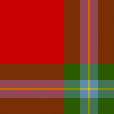
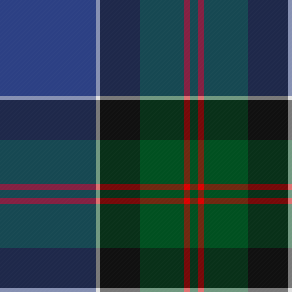
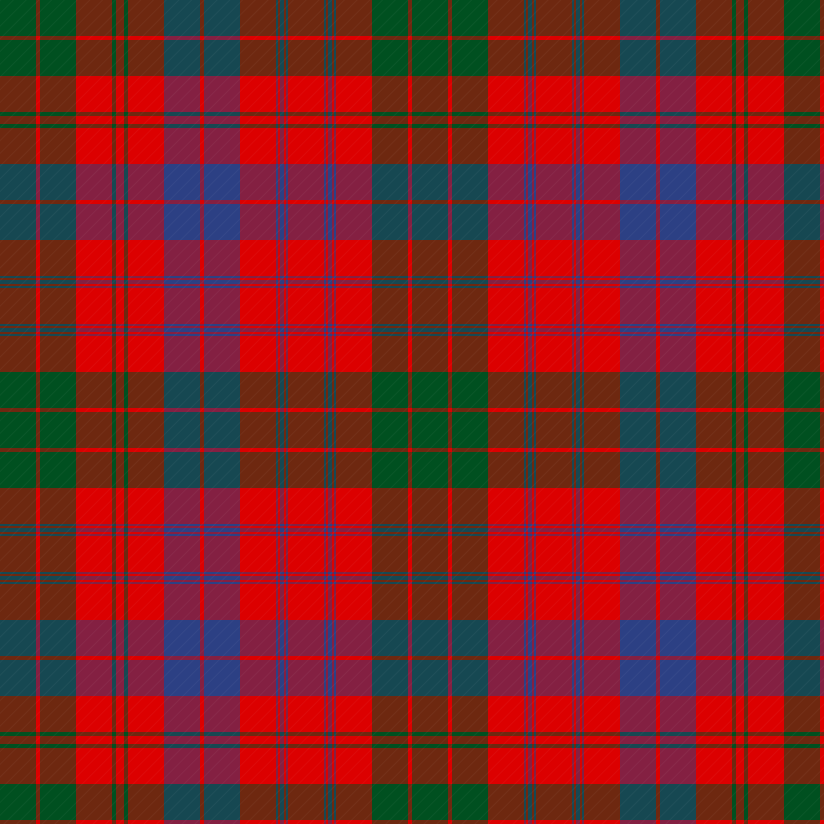
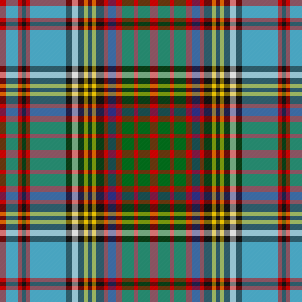
Section 07 called clan tartan a nineteenth-century construction, and the register bears that out. The Lochbuie and Ross setts both survive in the Cockburn Collection, gathered between 1810 and 1820; the Lochbuie sett was first published by Grant in 1886, and the McFadyen sett, which the register records as MacFadzean, and the Anderson are twentieth-century records of earlier samples.12 The register reveals threadcounts only to signed-in users, so these four are taken from published transcriptions of the same records and checked against two further collections.1314 Shade letters differ a little between collections; the structures agree.

Points, not territories

The map marks three places and no boundaries. Clan territory was a shifting matter of tenancy, kinship and force, contested at the time and contested now, so drawing an outline around either clan would be invention dressed as record. The Auld Sett of Maclaine of Lochbuie is missing from the swatches for a related reason: it is restricted to the chiefly family and needs the Chief’s written permission, so it is named here and not reproduced.15

Crest badge of Maclaine of Lochbuie: a branch of laurel and a branch of cypress in saltire, surmounted of a battleaxe, within a strap and buckle bearing the motto Vincere vel Mori. VINCERE VEL MORI

Maclaine of Lochbuie

A branch of laurel and a branch of cypress in saltire, surmounted of a battleaxe1

Vincere vel Mori — to conquer or die

Crest badge of Clan Ross: a dexter hand holding a garland of laurel, within a strap and buckle bearing the motto Spem Successus Alit. SPEM SUCCESSUS ALIT

Clan Ross

A dexter hand holding a garland of laurel2

Spem Successus Alit — success nourishes hope

Badges, not arms

Both are drawn here in line only, from the blazons cited in section 01. Neither reproduces the personal arms of Lorne Maclaine of Lochbuie or of Fiona Campbell Ross of Ross and Balnagowan, which are theirs and not the clan’s.

The Maclaine of Lochbuie tartan: a 114-thread sett in red, hunting green, azure and yellow.

Maclaine of Lochbuie

R/64 HG16 A8 Y/2

114 threads · STA 1462
Cockburn Collection, before 1810; published by Grant, 1886121315

The McFadyen tartan, recorded as MacFadzean: a 292-thread sett in blue, green, black, red and white.

McFadyen

B/96 W4 K40 G44 R6 G/8

292 threads · STWR 645, as MacFadzean
MacGregor-Hastie collection, Scottish Tartans Society archive1213

The Ross tartan: an 824-thread sett in red, green and blue.

Ross

G/36 R4 G36 R36 G4 R8 G4 R36 B36 R4 B36 R36 B2 R2 B4 R2 B2 R36 B2 R2 B4 R2 B2 R36 G36 R4 G/36

824 threads · STWR 864
Cockburn Collection, 1810–20; endorsed by D. C. Stewart1213

The Anderson tartan: a 302-thread sett in Anderson blue, red, black, green, gold, blue and white.

Anderson

R/6 AL12 R4 K4 R4 AL36 K6 W6 K6 DY4 K4 DY4 K8 R4 B8 R6 G12 R4 G12 R/8

302 threads · STA 1394
recorded c. 1900; Highland Society of London sample121314

Threadcount notation: capitals are colours, numbers are threads, / marks a pivot

Where the two clans held land A stylised outline of Scotland marking Lochbuie on the Isle of Mull, the seat of Maclaine of Lochbuie; Balnagown in Easter Ross, the seat of Clan Ross; and Applecross on the west coast, the hereditary abbacy the earls of Ross came from. Shetland is shown in an inset. Shetland LOCHBUIE Moy Castle, Isle of Mull APPLECROSS the hereditary abbacy BALNAGOWN Easter Ross
Seats and origins. Moy Castle stands at the head of Loch Buie on Mull; Balnagown is in Easter Ross; Applecross held the abbacy the earls of Ross came out of.19 Coastline simplified from Natural Earth.18

Family Tree

Draft

Built from a working Ancestry export of 130 individuals, 120 of them published and 10 living individuals withheld. It is a work in progress: some lines stop where the records do, and a few name fields still carry research annotations. The Ancestry view fans back through 13 generations from the youngest generation; Descent shows the same people as lines of descent from each earliest known ancestor. Names carrying a sept surname are marked.

outline view
  1. Livingwithheld
    1. Livingwithheld
      1. Livingwithheld
        1. Frederick Kingston1895–1969
          1. James William Kingston1864–?
            1. James John Kingston1832–1906
              1. James Kingston1810–?
            2. Elizabeth Roberts1833–1901
              1. William Roberts1810–1871
              2. Phoebe Charman1811–1886
                1. William Charman1778–1843
                  1. John Charman1728–1778
                    1. William Charman1695–1737
                      1. William Sefton Charman1674–1731
                      2. Elizabeth Farr 7ggm1671–1705
                    2. Mary Turle Tyrrell1692–1749
                      1. William Turle Tyrrell1670–1732
                      2. Mary Lancaster1667–?
                  2. Elizabeth\Bethia Bishop1744–1784
                    1. Richard Bishop1710–1751
                      1. Thomas Arthur Bishop II1670–1739
                        1. Thomas Bishop1650–1684
                        2. Elizabeth Russell1655–1684
                          1. James Russell1627–?
                      2. Susannah Susan Anne Upton1671–1745
                    2. Margaret Randell1710–?
                      1. Robert Randal1691–?
                      2. Elizabeth Smith?–1735
                2. Sophia Jenden1777–1848
                  1. William Jenden1745–1847
                    1. William Jendin1719–?
                      1. John Jenden1689–1741
                      2. Anne Boxall\Jenden1692–1743
                    2. Mary Edmunds1719–1801
                  2. Mary Bates1747–?
          2. Frances Kitchen1863–?
            1. Livingwithheld
        2. Nancy Jean Anderson1921–2014
          1. Albert James Anderson1885–1957
            1. John Anderson1857–1941
              1. Archibald McLaren Anderson1824–1892
                1. Jessie Powell1800–1880
              2. Janet Paul (Mrs Archibald Anderson)1830–1915
                1. William Paul1808–?
                2. Margaret MacGibbon (Mrs William Paul)1807–?
                  1. James McGIBBON1782–?
                  2. Janet URE1780–1841
            2. Ellen Keene Jnr1859–1941
              1. Thomas Keene1834–1876
                1. Thomas Keene1797–1877
                  1. James Keem Keene?–1804
                2. Mary Amelia HARNETT1798–1869
                  1. James Harnett1772–1823
                  2. Martha Quested1772–1846
                    1. John Quested1739–1822
                      1. Stephen Quested1710–1745
                      2. Damaris Horn1711–1792
                    2. Sarah HEAD*1743–1810
                      1. James Head1710–1790
                        1. John Head1684–1754
                          1. Joseph Head1636–1712
                          2. Winifred Paradise Bradshaw1645–1713
                        2. Elizabeth Roakes1685–1725
                      2. Elizabeth Webb1710–1803
              2. Ellen Sturt1834–?
                1. Thomas Sturt1801–1842
                  1. Thomas Sturt1770–1847
                  2. Elizabeth Field1777–1842
                2. Charlotte Matthews1806–?
                  1. Livingwithheld
          2. Christianna Louise Kemp1886–1951
            1. Thomas KEMP1850–1921
              1. Thomas Kemp1821–1887
                1. Thomas Kemp1784–1833
                2. Joanna Nicholls - Kemp1786–1859
              2. Catherine Lory1824–1911
            2. Christiana Batten1853–1912
              1. William Henry BATTEN1831–1885
                1. Alexander BATTEN1802–1876
                2. Catherine ROWE1806–1866
              2. Christiana (Kitty) Nankervis1829–1897
                1. James Nankervis1792–1870
                  1. John Nankervis1749–1838
                  2. Catherine (Christian) Nickless1752–1831
                    1. William Nickless1720–?
                    2. Elizabeth Mulles1720–?
                2. Johanna MERRIFIELD1800–1883
                  1. Peter MERRIFIELD1762–1843
                  2. Arrabella Williams1765–1843
      2. Livingwithheld
        1. James McFadyen
          1. John Mcfadyen1886–1956
            1. James McFadyen1857–1927
              1. John McFadyen?–1885
              2. Catherine Keefe1831–1885
                1. James O'Keefe or Keefe?–1885
                2. Margaret Foy1800–?
            2. Annie BENNETT1862–1926
              1. Peter Bennett 2GG1831–1870
                1. Arthur Bennett 3GG1793–?
                2. Bridget Connolly 3GG1792–?
              2. Bridget Drain 2GG1835–1894
                1. Patrick Drain1810–1860
                2. Mary Ann Morgan 3GG1819–1887
          2. Elizabeth McDonald1891–?
            1. John Macdonald1869–?
            2. Catherine Leddy1865–1950
              1. Daniel Leddy1821–1876
              2. Elizabeth Collins1839–1899
        2. Philipar Holt1920–2008
          1. Sampson burr Holt1875–1943
            1. Annie Holt1850–1924
              1. Edward Holt ♥1815–1885
                1. John Holt1782–1869
                  1. Benjamin Holt1752–1841
                  2. Sarah Pearson1755–?
                2. Sarah Emery ♥1792–1835
              2. Elizabeth Broome1818–1891
                1. John Broom aka Broome ♥1788–?
                2. Hannah BISHTON *1799–1830
          2. Hannah hotchkiss1877–?
            1. Henry Hodgkiss Iron Worker1845–1918
              1. Margaret Hodgkiss1807–?
            2. Sarah Smith1847–1910
    2. Livingwithheld

Select a person to see their details.

documented sept surname living, withheld

Sources

Each entry is tagged with the kind of source it is. Tertiary entries are encyclopaedic summaries and should be replaced with the works they rest on; they are marked so the weak links are visible.

1

Tertiary Clan Maclaine of Lochbuie, Wikipedia. en.wikipedia.org — origin, charter, Moy Castle, barony of Moy 1542, motto and crest, sept list.

2

Tertiary Clan Ross, Wikipedia. en.wikipedia.org — Gaelic Clann Anndrais, Balnagown, chiefship 2024, sept list including Anderson, Gillanders and MacAndrew.

3

Tertiary Fearchar, Earl of Ross, Wikipedia. en.wikipedia.org — Applecross descent, knighted 1215, earl by 1234, succession c. 1251.

4

Tertiary Hector Reaganach Maclean, 1st Laird of Lochbuie, Wikipedia. en.wikipedia.org — the two brothers and their separate charters.

5

Clan society Clan Maclaine of Lochbuie. maclaine.org — approved by the 26th chief, Lorne Maclaine of Lochbuie, 21st Baron of Moy; lists MacFadzean among the septs.

6

Secondary The MacFadyens of Mull, The McFadden Project — McFadyen occupation of Lochbuie before the Maclean charter, the arrow and the bone, later alliance and sept status. The site went offline during 2026 and its domain no longer resolves; an archived copy from April 2022 survives. Every claim it carried is also cited to a source that is still live.

7

Clan society The Ó Beólláin Earls of Ross, Clan Ross. greatclanross.org — the Ó Beólláin kindred and the hereditary abbacy of Applecross.

8

Secondary Frank Adam, The Clans, Septs and Regiments of the Scottish Highlands (1896) — the first published pairing of septs and dependents with clans.

9

Secondary Hugh Trevor-Roper, The Invention of Scotland: Myth and History (Yale University Press, 2008) — on the nineteenth-century construction of clan tartan and Highland tradition.

10

Peer-reviewed Towards a List of Clans and Families in Scotland: Identity Politics, Cultural Appropriation and Romantic Idealism, Genealogy. doi:10.3390/genealogy10020044 — on how clan and family lists are constructed and contested.

11

Clan society Sept by Any Other Name: Septs, Associated Families, and Memberships of Clan and Family Societies, COSCA. cosca.scot — the nineteenth-century commercial origin of sept lists.

12

Primary The Scottish Register of Tartans. Maclaine of Lochbuie (Coburn), STA 1462: ref 2591; MacFadzean, STWR 645: ref 2430; Ross, STWR 864: ref 3555; Anderson, STA 1394: ref 82 — dates, collections and palettes. Threadcounts on the register are shown only to signed-in users.

13

Secondary tartan-database, transcriptions of five published tartan collections. github.com/thetartan — the threadcounts and hex palettes the four swatches on this page are woven from.

14

Secondary Tartan Ferret, Scottish Tartans Authority. tartansauthority.com — independent record of the same setts, used to check them.

15

Clan society Tartans, Clan Maclaine of Lochbuie. maclaine.org — the red Coburn sett as the clan tartan, its 114-thread repeat, and the Auld Sett restricted to the chiefly family.

16

Tertiary Crest badge, Wikipedia. en.wikipedia.org — the strap and buckle, and the crest and motto belonging to the chief alone.

17

Tertiary Court of the Lord Lyon, Wikipedia. en.wikipedia.org — the Lyon King of Arms Act 1592, the power to fine and imprison, and the removal, destruction or forfeiture of items bearing another’s arms.

18

Primary Natural Earth, 1:10m admin‑0 map subunits, subunit Scotland. naturalearthdata.com — public-domain coastline, simplified for the map by tools/make-scotland-map.py.

19

Tertiary Coordinates of the three marked places, Wikipedia: Moy Castle 56.35583 N, 5.85861 W; Balnagown Castle 57.7494 N, 4.0806 W; Applecross 57.43304 N, 5.80958 W.

20

Secondary George F. Black, The Surnames of Scotland: Their Origin, Meaning and History (New York Public Library, 1946), quoted per surname at Maclean, McFadyen, Ross and Anderson — the standard dictionary of Scottish surnames, and the source of every dated name-form in section 06. Black gives the records; the reading of them here is mine.

21

Tertiary Clan Maclean, Wikipedia. en.wikipedia.orgClann 'IllEathain from MacGilleEathain, Gillean's dates, the Ragman Roll of 1296, and the papal dispensation of 3 May 1367 as the first Maclean in official record.

22

Tertiary Yogh, Wikipedia. en.wikipedia.org — “In Middle Scots orthography, the use of yogh became confused with a cursive z and the early Scots printers often used z when yogh was not available in their fonts”; Menzies, Dalziel and MacKenzie as the standard examples.

23

Clan society Clan Legends, Clan Maclaine of Lochbuie. maclaine.org — the 1360 charter, the barmkin, the arrow and the bone, the ox-hide ground plan, and the admission that most of the surviving tower is fifteenth-century with no contemporary record of a builder.

24

Tertiary Applecross, Wikipedia. en.wikipedia.org — Máel Ruba founds Aporcrosan in 672 and dies there in 722; the deaths of several successors as abbot are recorded in the Irish annals into the early ninth century.

25

Tertiary Anderson (surname), Wikipedia. en.wikipedia.org — son of Andrew, the Gaelic MacGhilleAndrais, the related MacAndrew and Gillanders, and the concentration of the name in the north-east.

26

Tertiary McFadyen (surname) and MacFadyen, Wikipedia. McFadyen · MacFadyen — the Gaelic Mac Phàidín and the sense “son of little Patrick”.